Progressive Overload Principles in Corrective Exercise Programs
March 19, 2026
10 min

Introduction
Welcome to Back in Action Bodyworks, where chiropractic care and holistic health intersect to create patient‑centered treatment plans. This article is crafted for our clients—whether recovering from injury, managing chronic low‑back pain, or seeking optimal musculoskeletal performance. It explains two foundational concepts that guide our approach: progressive overload and the Corrective Exercise Continuum (Inhibit → Lengthen → Activate → Integrate). Progressive overload, a core principle of the NASM OPT model, ensures that load, volume, or intensity increase gradually (≤10 % per week) to stimulate adaptation while protecting joint health. The continuum provides a systematic roadmap for re‑educating movement patterns before adding demand. By combining these evidence‑based strategies with chiropractic alignment, we deliver natural pain relief, improved function, and lasting wellness.
Foundations of Progressive Overload
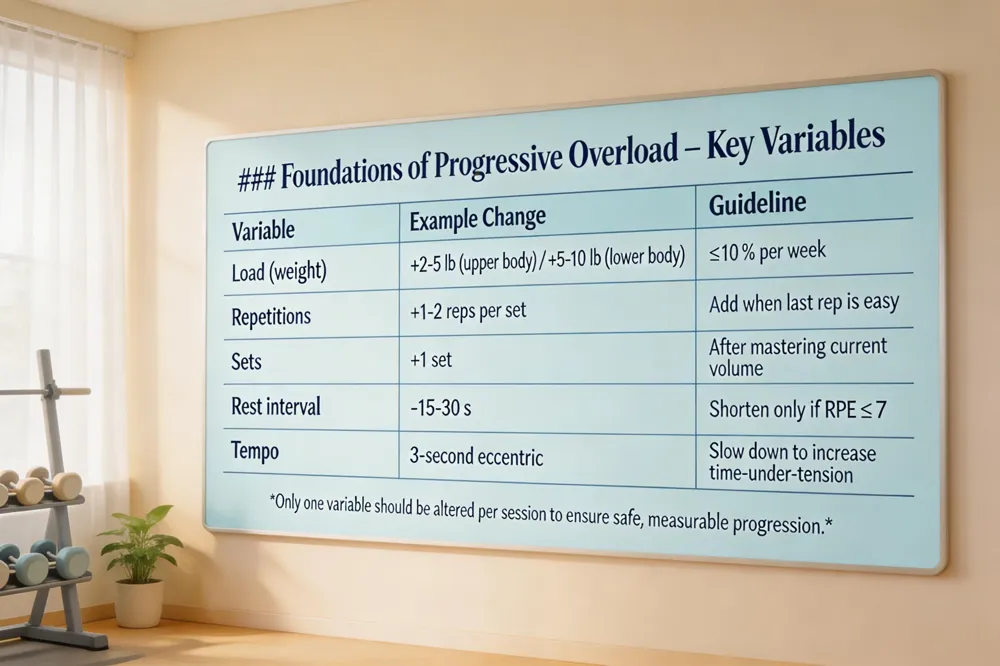 Why does overload matter? Incremental increases keep muscles in a state of challenge, fostering strength gains and hypertrophy while preventing plateaus. This principle also supports corrective exercise programs, where overload can be introduced through variables such as range of motion, tempo, or exercise complexity—allowing clinicians to enhance joint stability without compromising movement quality.
What is progressive overload in weight training? Progressive overload is the principle of gradually increasing the stress you place on your muscles during weight training so they are forced to adapt, grow, and become stronger. This can be done by adding more weight, doing extra repetitions, increasing the number of sets, shortening rest periods, or slowing the tempo of each movement. By consistently challenging the muscles with a slightly greater demand than the previous session, you stimulate mechanical tension, muscle damage, and metabolic stress—key drivers of strength and hypertrophy. The approach ensures continual improvement and helps prevent plateaus, while allowing you to adjust one variable at a time for safe, sustainable progress. In a typical routine, you might increase the load by a few pounds or add a couple of reps each week, keeping the workout challenging but within your ability to maintain proper form.
Is progressive overload good? Yes—progressive overload is a fundamental principle for building strength, muscle size, and endurance, and it helps prevent plateaus by continuously challenging the musculoskeletal system. By gradually increasing weight, repetitions, sets, or reducing rest time, you stimulate adaptation without overloading the body all at once. When applied responsibly—typically increasing load by no more than 10 % per week and allowing adequate recovery—it minimizes injury risk and supports long‑term joint health. This steady, measurable progression is especially valuable for adults seeking to maintain functional fitness as they age. As with any exercise program, it’s wise to consult a qualified practitioner, such as a chiropractor or physical therapist, to tailor the overload to your individual needs and ensure safe technique.
The NASM Corrective Exercise Continuum (CEx)
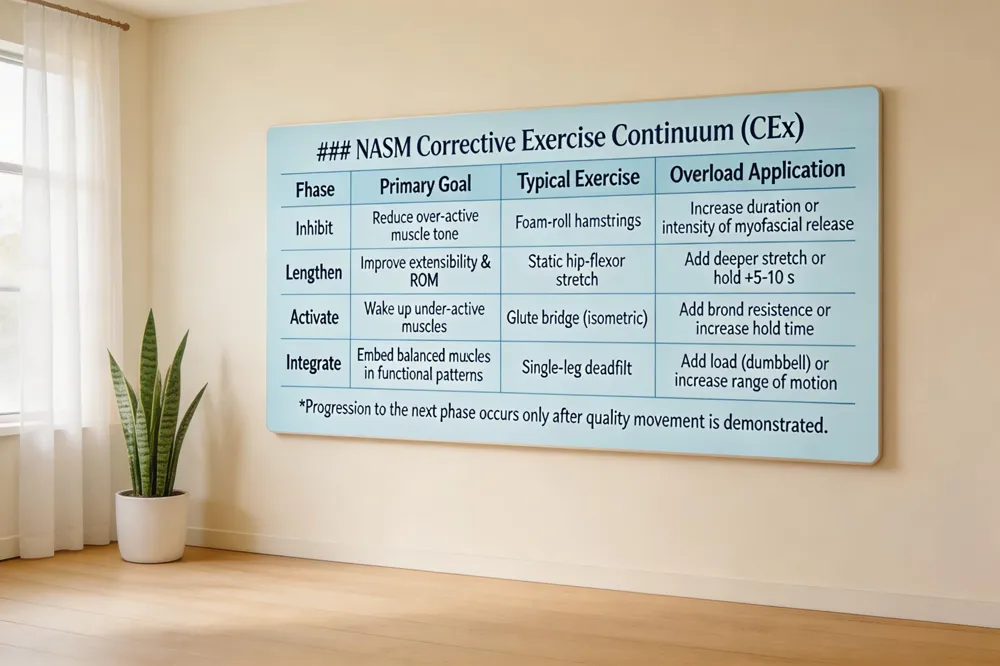 The NASM Corrective Exercise Continuum (CEx) follows a four‑step sequence—Inhibit, Lengthen, Activate, Integrate to restore balanced movement.
Inhibit uses myofascial release (foam rolling, percussion) to quiet overactive muscles, preparing tissues for safe stretch.
Lengthen applies static or dynamic stretching to increase extensibility and joint range of motion.
Activate introduces isolated, low‑load drills that “wake up” underactive muscles; isometric holds are central in this phase, providing joint‑stable, low‑stress activation that improves motor‑unit recruitment without compromising alignment.
Integrate combines the newly balanced muscles into multi‑joint, functional patterns that reinforce proper mechanics and enhance performance.
Corrective Exercise Continuum – The CEx is a four‑step model that systematically addresses muscular imbalances, moving from inhibition of overactive tissue to functional integration.
Isometric exercises are used in which phase of corrective exercise programming – Isometric holds are primarily employed during the Activate phase, allowing clinicians to cue precise muscle activation while maintaining joint stability.
By progressing through each phase, clinicians can apply progressive overload safely: load, volume, or complexity are increased only after the client demonstrates quality movement in the preceding step, ensuring continuous adaptation without injury.
Designing a Corrective Exercise Program
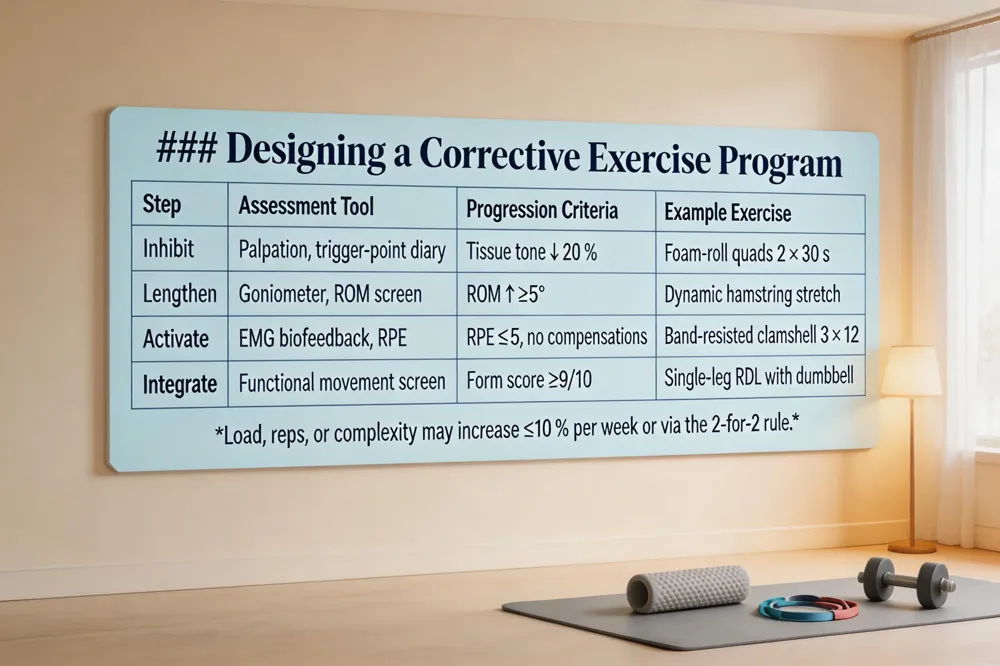 Assessment and identification of imbalances – A thorough initial assessment (movement screens, pain questionnaires, and joint‑alignment checks) reveals over‑active, shortened, or weak muscles. NASM’s Corrective Exercise Continuum (CEx) uses this data to prioritize tissue‑quality work before adding load.
Sequencing the CEx phases – The program follows four steps: Inhibit (foam‑rolling or percussion to reduce tone), Lengthen (static/dynamic stretches to improve extensibility), Activate (motor‑control drills such as glute bridges or scapular retractions to strengthen under‑recruited muscles), and Integrate (multi‑joint functional movements like squats or overhead presses). Each phase prepares the tissue for the next, ensuring safe progression.
Individualization and progression criteria – Progression is patient‑centered: increase load, reps, tempo, or range of motion by ≤10 % per week, or use the 2‑for‑2 rule (add weight after two extra reps for two sessions). Monitor Rate of Perceived Exertion and Reps In Reserve to adjust intensity without compromising form.
Safety considerations – Maintain proper technique, respect pain thresholds (≤2/10), and incorporate deload weeks. If movement quality regresses, return to an earlier CEx phase.
Corrective exercise program principles examples – Begin with foam‑rolling (Inhibit), stretch hip flexors (Lengthen), perform clamshells (Activate), then progress to single‑leg deadlifts (Integrate). Incrementally add resistance bands or light dumbbells while preserving alignment.
Principles of corrective exercise – Restore tissue quality, then move of joint, range, and finally motor control. Individualize each step to the client’s impairments and goals, advancing only when mastery is demonstrated.
Principle of overload example – A client who can hold a plank for 30 seconds progresses to 45 seconds or adds a weighted vest, providing a modest, controlled increase in demand that stimulates strength without injury.
Applying Progressive Overload Within Corrective Exercise
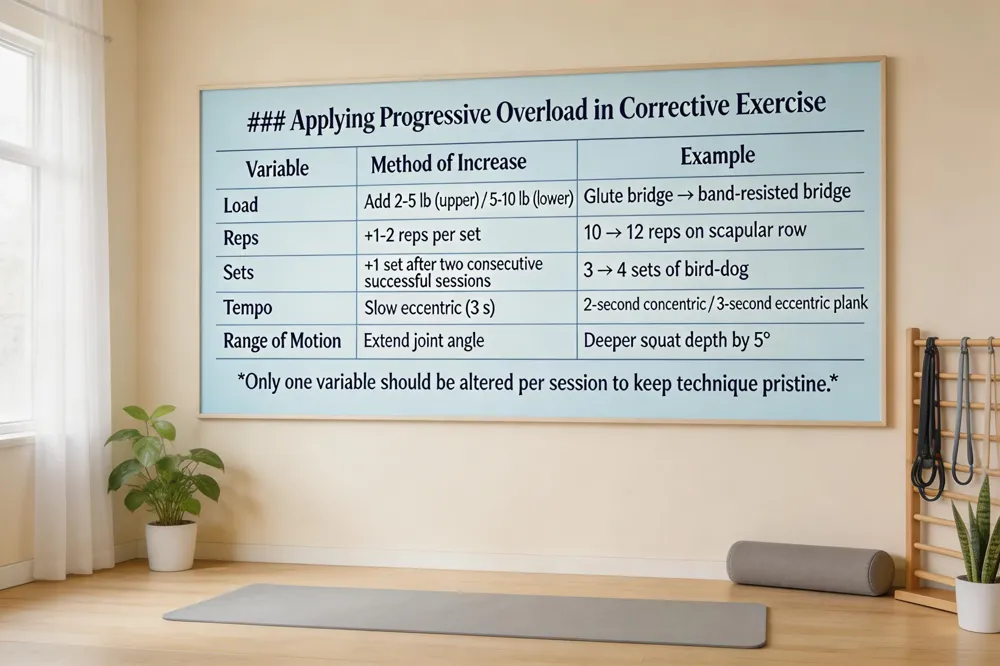 Progressive overload in corrective exercise examples – Gradual load, volume, or difficulty increases while maintaining form; e.g., glute bridges → band‑resisted → single‑leg, scapular rows → extra sets or tempo work, core planks → weighted or unilateral variations.
How do I do progressive overload correctly? – Change only one variable per session, use modest increments (2‑5 lb upper body, 5‑10 lb lower body), track performance, and adjust every 1‑2 weeks, ensuring technique stays pristine and pain stays ≤2/10.
Progressive overload example – Squat progression: 3 × 10 reps at 50 lb, then 55 lb after two weeks or add reps to 12, later add a set or cut rest intervals, always monitoring form and recovery.
Monitoring Load, Recovery, and Safety
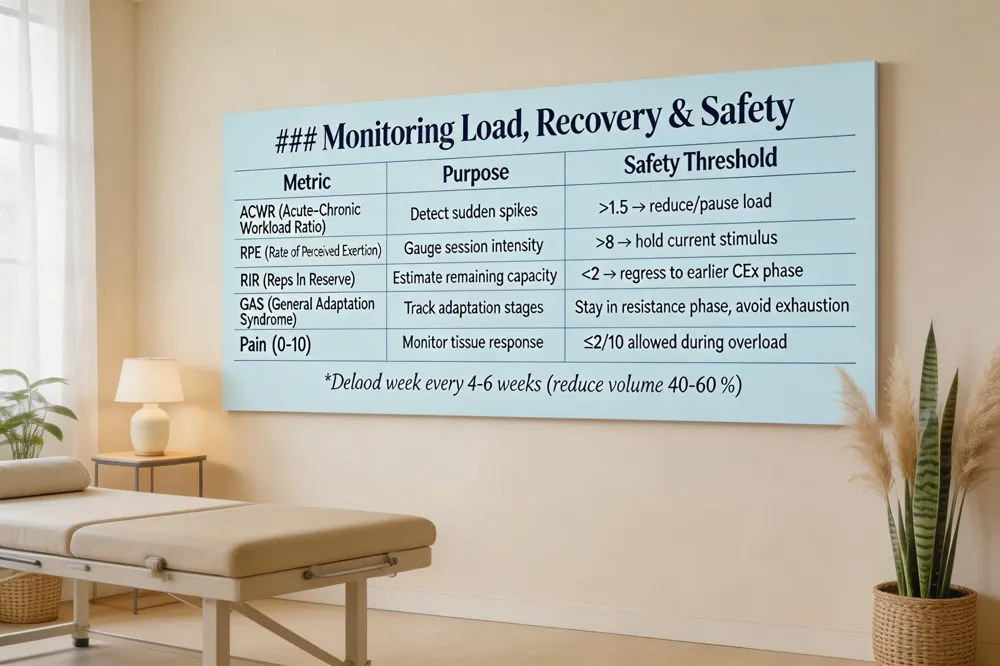 General Adaptation Syndrome (GAS) – The body’s response to progressive stress follows the alarm‑resistance‑exhaustion cycle. In chiropractic‑guided corrective programs we aim to keep clients in the resistance phase, using modest weekly increases (≤10 % load) to stimulate mechanical tension without triggering exhaustion.
Acute‑Chronic Workload Ratio (ACWR) – Tracking the ratio of the most recent week’s stress to the average of the past month helps prevent spikes that raise injury risk. An ACWR above 1.5 signals a need to pause or reduce load before the next session.
RPE/RIR as real‑time feedback – Rate of Perceived Exertion and Reps‑In‑Reserve give instant insight into a client’s readiness for more demand. When RPE exceeds 8 or RIR falls below 2, the clinician should hold the current stimulus or regress to the Inhibit/Lengthen phases.
When to deload or pause progression – Incorporate a deload week every 4‑6 weeks (reduce weight 10‑20 % or increase rest) to allow tissue remodeling and neural recovery. If pain rises, form degrades, or ACWR spikes, pause overload and reassess movement quality before resuming.
Q: Should you progressive overload every workout? No; increase load only when form is solid and recovery is adequate—often weekly or bi‑weekly.
Q: How often should you progressive overload? Typically every 1‑2 weeks, or add a small increment each session if reps are completed comfortably.
Q: Is training to failure progressive overload? Failure can signal when to add load, but progressive overload is broader—systematic, incremental stress without必 technical failure.
Q: Progressive overload study – A 10‑week trial showed equal strength and hypertrophy gains from adding weight or reps, confirming either method works for beginners when applied safely.
Periodization, Deloads, and Long‑Term Programming
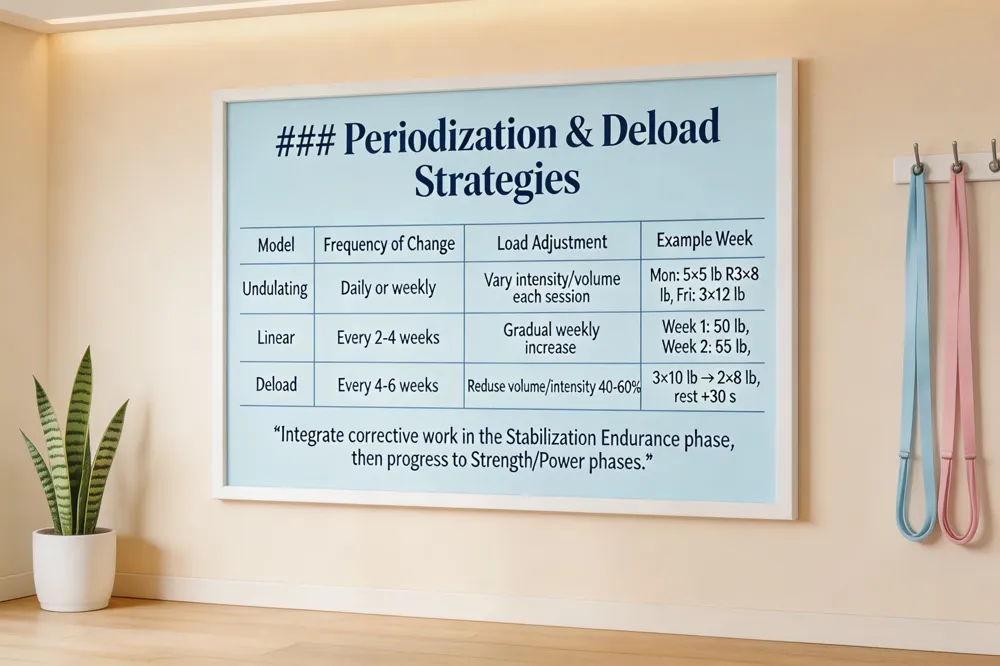 Deload weeks—typically every 4‑6 weeks—reduce volume or intensity by 40‑60 % to allow tissue repair, neural reset and pain‑level monitoring, which is essential for long‑term musculoskeletal health and for clients with chronic back issues.
Undulating periodization varies intensity and volume daily or weekly, while linear periodization follows a steady, step‑wise increase. Both can be used with corrective work; undulating offers frequent stimulus changes that keep motor learning fresh, whereas linear provides a clear, gradual pathway for patients who need more consistency.
Integrating corrective exercises into the OPT model means using the Stabilization Endurance phase to build joint stability, then applying progressive overload in the Strength and Power phases while preserving movement quality.
Progressive overload workout plan: A structured program that adds 2‑5 % weight, reps, or sets each week, rotates upper‑body, lower‑body, and full‑body days, includes mobility drills, and incorporates a deload after 4‑6 weeks.
Progressive overload Workout Plan PDF: A free 2‑week, 30‑minute‑a‑day strength plan with tracking sheets, core lift cues, and optional 12‑week progression, available for download from Back in Action Bodyworks.
Progressive overload in corrective exercise Reddit: Users recommend starting with low‑intensity, high‑frequency body‑weight or band work, then gradually increasing resistance, volume, or complexity as movement quality improves, always tracking pain and range‑of‑motion to ensure safe, functional progression.
Targeted Lower‑Back Strengthening and Pain Relief
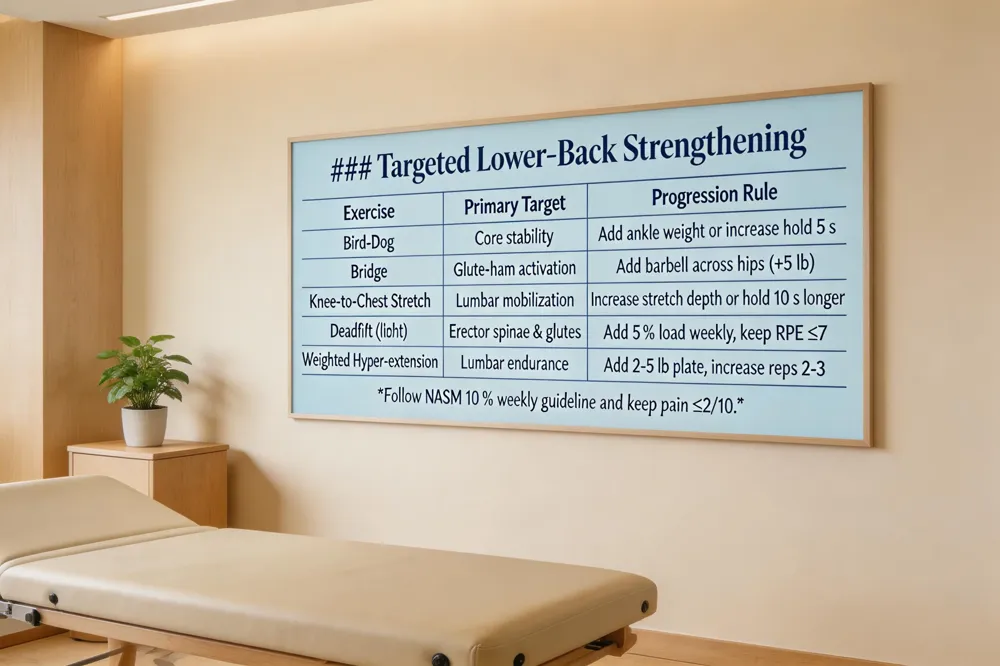 A holistic, patient‑centered plan for low‑back health blends chiropractic care with evidence‑based progressive overload. In the gym, core compound moves such as deadlifts, rack pulls, and barbell good‑mornings engage the lumbar erector spinae while strengthening glutes and hamstrings for balanced support. Isolation work—back extensions on a Roman chair, weighted hyper‑extensions, and single‑leg RDLs—adds endurance, and a brief stretch routine (cat‑cow, seated forward folds, thoracic rotations) maintains flexibility.
Three essential home exercises are the Bird‑Dog (core stability), Knee‑to‑Chest Stretch (lumbar mobilization), and the Bridge (glute‑ham activation). The Bridge is often the single most effective movement for pain relief because it simultaneously stabilizes the spine, improves pelvic alignment, and reduces disc pressure.
A simple daily routine includes pelvic tilts, bridges, cat‑cow, child’s pose, bird‑dog, knee‑to‑chest, and seated spinal twists—seven exercises that together enhance movement quality, reduce pain, and support long‑term musculoskeletal health. Progression follows the NASM 10 % weekly guideline, using RPE or RIR to ensure safe overload while preserving technique.
Educational Resources and Professional Credentials
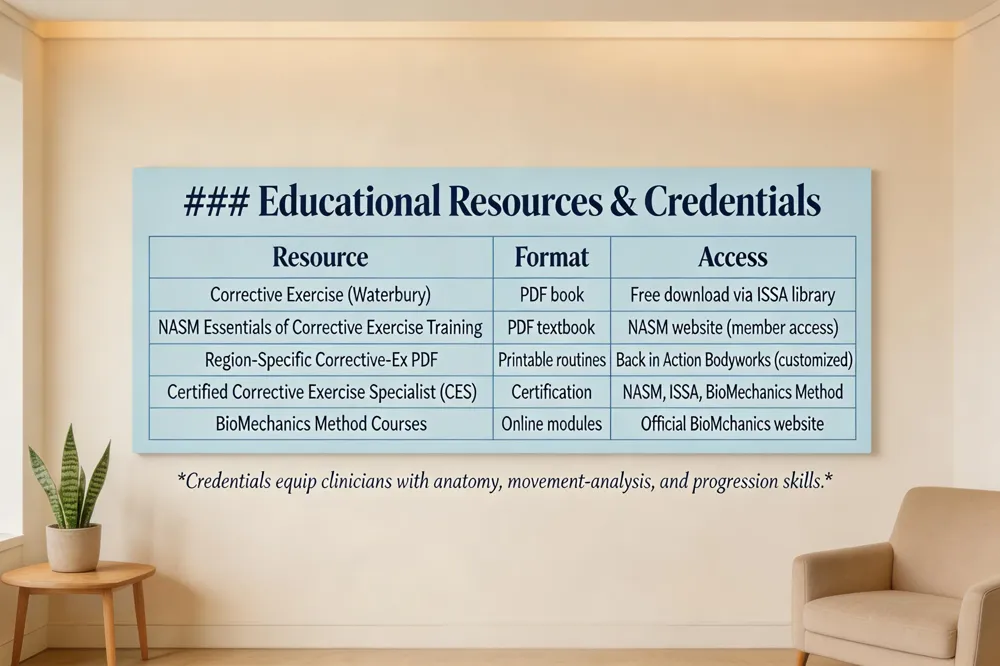 Chiropractors and holistic health practitioners at Back in Action Bodyworks rely on a suite of trusted educational tools to guide patient‑centered corrective exercise programs. The free Corrective Exercise book by Chad Waterbury, DPT, can be downloaded as a PDF from the ISSA resource library; it offers a three‑level framework, mobility drills, stabilization cues, and progression tables for the cervical spine, shoulder, thoracic region, and core. NASM’s Essentials of Corrective Exercise Training PDF—available through the NASM website—serves as the core textbook for the Corrective Exercise Specialist (CES) certification and outlines assessment, programming, and periodization strategies aligned with the OPT model. A generic corrective‑exercises PDF provides printable, region‑specific routines that move from activation to integration, and Back in Action Bodyworks supplies a customized version for home use. Finally, earning a Corrective Exercise certification (NASM, ISSA, or BioMechanics Method) equips clinicians with anatomy, movement‑analysis, and progression skills, enabling evidence‑based, non‑pharmacologic interventions that complement chiropractic care and support long‑term musculoskeletal health.
Practical Tips for Beginners and Home Training
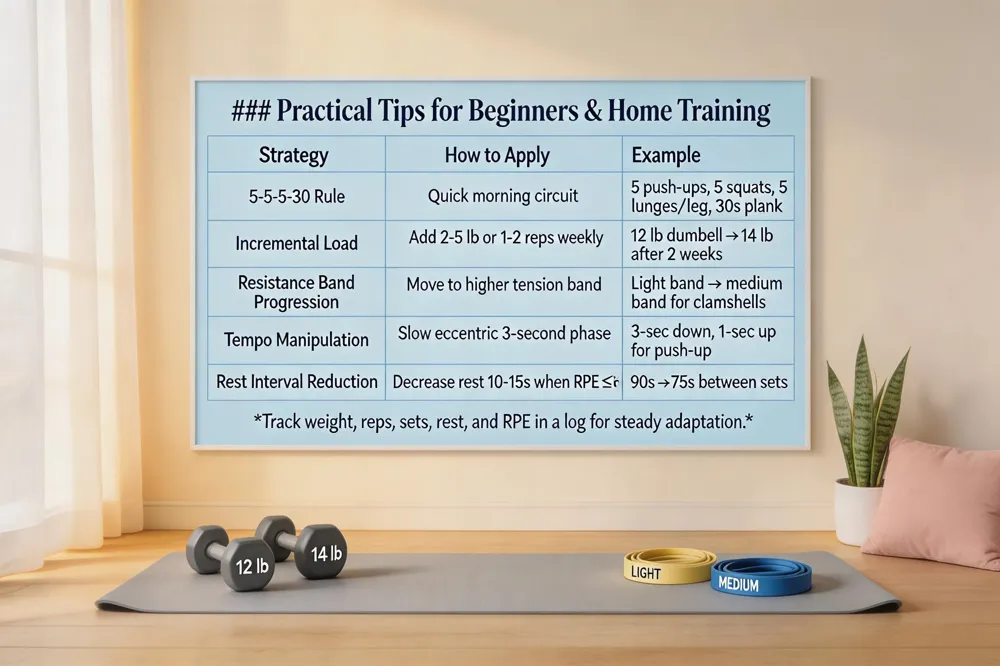 Progressive overload for beginners is the cornerstone of safe strength development. Start with a weight that lets you finish the prescribed reps with flawless form, then increase the load by 2‑5 % each week once the set feels easy. If weight isn’t available, add one or two extra repetitions, an additional set, or slow the tempo (e.g., 3‑second eccentric) to raise the stimulus while preserving joint alignment—an approach championed by NASM and chiropractic specialists for holistic musculoskeletal health.
How to apply progressive overload for beginners – Choose a handful of fundamental moves (squat, push‑up, row) and perform 3 sets of 8‑12 reps. When the last rep is comfortable, bump the dumbbell by 2‑5 lb or add a rep. Adjust only one variable every 1‑2 weeks, tracking weight, reps, sets, and rest in a log to ensure steady adaptation without overtraining.
How to apply progressive overload at home – Use body‑weight or resistance bands as a baseline. Each week, increase one variable: a heavier band, an extra rep, a new set, or a shorter rest interval. Rotate variations (single‑leg squat, elevated plank) to challenge muscles from new angles while maintaining perfect technique.
What is the 5‑5‑5‑30 rule? – This quick morning circuit (5 push‑ups, 5 squats, 5 lunges per leg, 30‑second plank) awakens the nervous system, promotes core stability, and supports spinal alignment—key goals of corrective chiropractic care.
Conclusion
Progressive overload remains the cornerstone of effective corrective exercise, gently increasing load, volume, tempo, or complexity to keep the neuromuscular system adapting while preserving joint integrity. Safety starts with a thorough assessment of movement quality, pain thresholds, and functional goals; each variable is adjusted one step at a time, using tools such as RPE, RIR, and the 2‑for‑2 rule to ensure progression is both measurable and tolerable. By tailoring the overload to the individual’s injury history, lifestyle, and recovery capacity, clinicians can enhance strength, stability, and pain relief without overtraining. Ready to experience a personalized, holistic program? Schedule a consultation at Back in Action Bodyworks today.
Recent articles
10 Real‑Patient Success Stories Showcasing the Impact of Chiropractic Care

Superfoods That Boost Nerve Healing After Chiropractic Sessions

Sleep Positions That Promote a Healthy Back Alignment
Signs Your Chiropractor Is a Good Fit for Your Back Pain Goals
Case Study: Integrated Physiotherapy and Chiropractic for Faster Recovery
First-Time Chiropractic Visit: A Step‑by‑Step Walkthrough
Synergistic Benefits: Combining Physiotherapy with Chiropractic Care

Beyond Surgery: Holistic Approaches to Managing Back Pain

How Manual Therapy Enhances the Effects of Chiropractic Adjustments

Hydration Hacks: Why Water Matters for Joint and Spine Function

What Does a Comprehensive Spinal Evaluation Include?

Success Spotlight: Transformative Results After Six Weeks of Chiropractic Treatment

Understanding the Initial Assessment Process in Chiropractic Care
Designing a Personalized Corrective Exercise Plan for Chronic Pain Management

Natural Pain Management: Combining Acupuncture, Yoga, and Chiropractic
Chiropractic Care vs. Pain Meds: Long-Term Outcomes for Back Pain Sufferers

What to Expect During a Sciatica‑Focused Decompression Session

Understanding the Pain-Relief Mechanics Behind Chiropractic Adjustments

Success Rates of Non‑Surgical Spinal Decompression for Sciatica
Patient-Centered Chiropractic Care: Personalized Plans for Back Pain Relief
How Chiropractic Treatments Reduce Inflammation and Speed Up Back Pain Recovery
Real‑Life Stories: How Chiropractic Helped Patients Overcome Chronic Back Pain

From Symptom Masking to Root‑Cause Healing: A Practical Guide

6 Holistic Non‑Surgical Treatments That Deliver Sustainable Back‑Pain Relief

Key Questions to Ask When Selecting Your Chiropractor
Mindful Movement: Incorporating Stretch Breaks Into a Busy Day

Why Targeting the Underlying Cause Beats Temporary Symptom Relief

8 Ways Physiotherapy Complements Chiropractic Adjustments for Faster Recovery
Meal Planning for Athletes Recovering from Back Injuries

9 Everyday Lifestyle Tweaks to Preserve a Healthy Spine and Prevent Pain

Functional Movement Screening for Root‑Cause Pain Identification

6 Things You’ll Experience During Your First Chiropractic Appointment

Spinal Decompression vs. Standard Physical Therapy for Sciatica: A Comparative Review

New Findings on How Adjustments Influence Blood Circulation
Work‑From‑Home Ergonomics: A Blueprint for a Pain‑Free Back

The Link Between Chiropractic Care and Improved Sleep Quality

Physiotherapy Techniques That Strengthen the Benefits of Chiropractic Adjustments

Biomechanical Insights Behind Successful Spinal Decompression

Desk‑to‑Dumbbell: Lifestyle Shifts That Guard Your Lower Back
10 Corrective Exercises for Sustainable Pain-Free Living

Morning Routines That Support Spine Health and Reduce Stiffness

Calcium and Magnesium‑Focused Nutrition for Bone Density and Spine Health

9 Ways Chiropractic Care Transforms Back Pain Management

Testimonial: Nutrition‑Guided Recovery Accelerated by Chiropractic
Science‑Backed Spinal Decompression for Relieving Sciatica Symptoms

Key Questions to Ask During Your Initial Chiropractic Consultation
Whole‑Body Wellness Blueprint: Nutrition, Exercise, and Chiropractic Synergy
A 12‑Week Corrective Exercise Blueprint for Chronic Neck Discomfort

Manual Therapy Plus Targeted Exercise: Accelerating Post‑Injury Recovery
Home‑Based Spinal Decompression Devices: What Patients Should Know

Chiropractic Care Statistics: Reducing Lost Workdays From Back Pain

How Targeted Nutrition Enhances Immune Function and Lowers Inflammatory Pain

Self‑Assessment Tools to Identify Hidden Triggers of Back Pain
Preparing for Your First Chiropractic Appointment: A Practical Checklist

Back Pain Relief Benefits: Lower Opioid Use and Better Quality of Life

Foam‑Rolling Techniques to Complement Chiropractic Adjustments
Progressive Overload Principles in Corrective Exercise Programs

Six‑Month Transformation: Integrated Care Success Story

7 Nutritional Hacks to Boost Your Overall Wellness

How to Choose a Chiropractor: Credentials, Techniques, and Patient Compatibility

5 Ways Spinal Decompression Can Ease Sciatica Pain

Overcoming Sciatica: A Patient’s Multidisciplinary Treatment Journey
Lifestyle Changes That Promote a Healthy Spine
Physiotherapy as a Complement to Chiropractic Treatments
6 Ways Physiotherapy Enhances Chiropractic Treatment Outcomes
Daily Living Tips for a Strong and Healthy Spine

How Physiotherapy Enhances Chiropractic Outcomes
Holistic Treatments: Alternatives to Surgery for Pain Relief
Inspiring Patient Success Stories from Chiropractic Clinics

Integrating Physiotherapy with Chiropractic Treatments
Corrective Exercise Routines for Chronic Pain Prevention
10 Corrective Exercises to Maintain a Healthy Spine and Relieve Pain
Exercise Strategies for Long-Term Pain Management
10 Corrective Exercises to Maintain a Healthy Spine and Relieve Pain
The Importance of Treating the Root Cause of Pain
Nutritional Support Strategies for Whole-Body Wellness
7 Essential Questions to Ask When Choosing Your Chiropractor
Identifying and Addressing Root Causes of Pain
Maintaining a Healthy Spine with Lifestyle Adjustments
Sciatica Symptom Relief via Spinal Decompression
8 Reasons Why Addressing the Root Cause of Pain Is Crucial
Chiropractic Care’s Impact on Back Pain Recovery
Combining Physiotherapy with Chiropractic Care for Better Results
Inspiring Recovery: Chiropractic Patient Testimonials
Nutritional Counseling Tips for Optimal Wellness

Why Addressing the Root Cause of Pain is Crucial
Back Pain and Chiropractic Care: A Winning Combination
Chiropractic Care Benefits You Might Not Know
Exploring Holistic and Non-Surgical Treatments for Pain
Spinal Health: Lifestyle Tips for Everyday Wellness
Spinal Decompression Therapy: Benefits and Applications
Holistic and Non-Invasive Spine Care Options
Everyday Lifestyle Advice to Keep Your Spine Healthy
The Significance of Treating Root Causes in Pain Therapy
Best Corrective Exercises for Sustainable Pain Management
Addressing Underlying Causes of Pain for Long-Term Relief
6 Key Benefits of Spinal Decompression Therapy for Sciatica Relief

How Nutritional Counseling Supports Spine Health and Recovery
The Role of Physiotherapy in Supporting Chiropractic Treatments